Mar 1, 2022 | Featured post, News
The ECTN General Assembly will take place on 8 – 9 APRIL 2022 at the Institute for Food Science and Technology, Hungarian University of Agriculture and Life Sciences, Buda Campus, Budapest, Hungary.
The meeting website is now open at:
https://ectnga2022.mke.org.hu/
The registration deadline is March 7 and the payment deadline is March 25.
There will be an election for EChemTest User Representative on the VEC committee.
This post is open to any ECTN Member. If you, or someone from your institution, wish to stand for election, please send an e-mail to the election officer, generalsecretary@ectn.eu before the deadline of 1st April 2022 The message should provide the name and institution of the nominee, and a very brief (a few lines) account of the EChemTest experience of the nominee. No other formalities are required.
Quoting our President, Sanjiv Prashar:
Despite these difficult times I hope as many of you that can, will join us in Budapest and participate in this vibrant project that we share.
Our network has many aims and objectives but for me the most important goal is the integration of European chemists, be they researchers and/or educators. For this human interaction is by far the most important reagent and although Zoom and Teams have come to our rescue, nothing can replace the in-person warmth and good will that is the essence of our meetings.
These are exciting times for the ECTN. Firstly, our General Assembly will be asked to approve a complete overhaul of the working groups and several new ones will be presented. Members will be invited to participate at all levels. These new groups will cover topics such as lecturer accreditation, Tuning revisited, ECTN digitalization and chemistry in society.
Our three standing committees Labels, Virtual Education Community and Quality Standards in Teaching, have been revamped with new faces that will surely continue and extend the excellent work that is being carried out in the name of the ECTN.
This year we have the good fortune to participate in two projects financed by the Erasmus Plus Programme, namely, STEM Continuous Professional Development at European Universities (STEM-CPD@EUni) and Digital Support in Chemistry Teaching (DISTINCT). Both projects are looking to recruit ECTN members to work and develop different aspects of each project. Presentation at our annual meeting will be made by the respective project coordinators Iwona Maciejowska and Marek Frankowicz
So, exciting times for all. You don’t want to miss out. Register now and I will see you in Budapest where a memorable chemistry reaction will no doubt take place.
Jan 25, 2022 | Featured post, News
The ECTN is a partner in a new Erasmus+ project entitled DISTINCT. It is coordinated by the Jagiellonian Universityin Krakow, Poland (Marek Frankowicz).
We are now partners in two Erasmus+ projects, DISTINCT and STEM-CPD@EUni.
Details of the STEM-CPD@EUni project can be found on the ECTN website. Details of the DISTINCT project are given below.
DISTINCT Project File
| Project type |
Educational |
| Call |
ERASMUS+ Key Action 2 Partnership for Cooperation 2021 |
| Project number |
2021-1-PL01-KA220-HED-000027619 |
| Title of the project |
Digital Support in Chemistry Teaching (DISTINCT |
| Number of months |
36 |
| Start and End Date |
01/11/2021 – 31/10/2024 |
| Project partners |
1. Jagiellonian University in Krakow, Poland – JU (project leader)
2. University of Bologna, Italy – UNIBO
3. Technical University of Vienna, Austria – TUWIEN
4. Vilnius College, Lithuania – VIKO
5. University of Latvia, Latvia – LU
6. European Chemistry Thematic Network Association, Belgium – ECTN |
| Total budget |
340 625 EUR |
| Project Summary |
The aim of the project is to support digitalization of European chemical faculties/departments to adjust them to the new post-COVID reality.
Four main strands of activities are planned:
1) Analysis of the situation, creation of a European database of good practices
2) Support for distance learning – lectures and seminars
3) Support for practical education (laboratory classes)
4) Support for school education and training in the chemical sector and development of recommendations for the organization chemical studies in crisis situations.
Instructions, training materials and teaching materials, including multimedia materials, will be developed and disseminated. Recommendations for various target groups will be elaborated. Dissemination activities for institutions outside the consortium (schools, universities, vocational training institutions) will be organized.
Particular attention will be paid to the problem of remote assessment and analysis of learning outcomes to be implemented as part of remote education. Training materials will also take into account issues such as remote work hygiene, “netiquette” (proper online behavior) and problems related to the GDPR and the protection of intellectual property.
Participation in the project of the ECTN ensures its European dimension and guarantees durability of its results. The impact of the project is also ensured by the appropriate consortium composition: the Jagiellonian University and the University of Bologna are members of the Coimbra Group and the UnaEuropa consortium, the University of Latvia belongs to UNICA (a network of universities from the capitals of Europe) and Vilnius College is an active member of EURASHE (European Association of Institutions of Higher Education).
Moreover, the University of Latvia is a coordinator and the Jagiellonian University is a partner in a large ERASMUS + project for the modernization of doctoral studies in Russia, Armenia and Belarus (focused on science, natural and technical studies), hence the results of the DISTINCT project will be also used outside EU countries. The activities carried out under the project will also be correlated with the work of the Polish Sector Skills Council for the Chemical Sector, and the developed recommendations will be made available to accreditation committees and other organizations operating in the field of higher education. |
Planned Results and Activities:
| Result |
Leader/
Co-leader |
Activities |
| DISTINCT Platform |
JU/LU |
1.1 Development of the DISTINCT platform for collection of cases
1.2 The query on internet resources and analysis of the collected questionnaires
1.3 Investigation of the needs and offers affecting the effectiveness of teaching and learning process
1.4 Mapping/collecting, structuring/classifying good practices and innovative solutions
1.5 Development of self-learning modules |
| Remote Lecturing Support Toolkit |
UNIBO/JU |
2.1 Definition of the guideline contents
2.2 Identification of key persons (experts) for each content
2.3 Completion of the modules
2.4 Testing and evaluation of the guidelines
2.5 Publication of guidelines |
| Remote Laboratory Support Toolkit |
TUWIEN/JU |
3.1 Assessing the current laboratory situation
3.2 Re-designing/modifying laboratory
3.3 Assessment of online alternatives
3.4 Possibilities for remote group work
3.5 Grading of practical courses held in remote format |
| Stakeholders Support & Policy Recommendations |
ECTN/VIKO |
4.1 Recommendations for universities
4.2 Recommendations for chemistry sector
4.3 Recommendations for schools
4.4 Multiplier events
4.5 Creation of DISTINCT Community of Practice |
We will have the kick-off meeting ONLINE on 2 February 2022, to which all ECTN Members are invited to attend. A link for attending the meeting will be sent to all ECTN Members.
The agenda:
Open session (we can invite persons from the outside of our consortium, to inform them on our project):
10:00 – 10:30 Opening session
10:30 – 12:00 Presentation of partner institutions (15 minutes/partner)
12:00 – 12:15 Break
12:15 – 13:15 Presentation of planned activities (15 minutes/result: R1 – JU, R2 – UNIBO, R3 – TUWIEN, R4 – ECTN)
Restricted session (only for DISTINCT participants):
14:00 – 15:00 Administrative & financial issues
15:00 – 15:30 Work Plan for February – June 2022
Sep 29, 2021 | Featured post, News
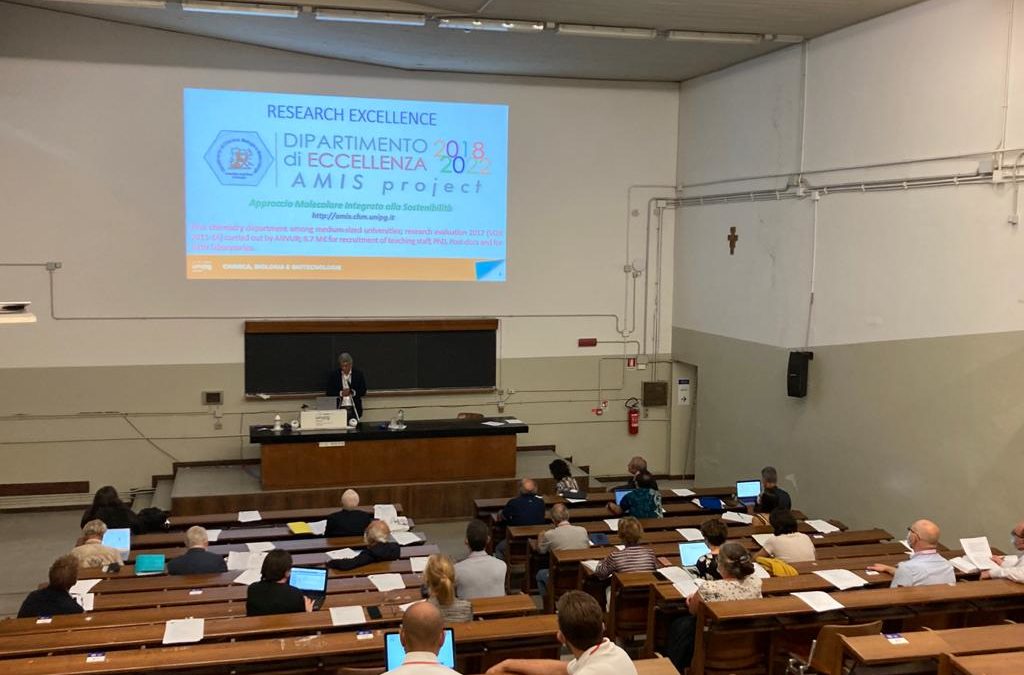
The ECTN General Assembly took place at the Department of Chemistry, Biology and Biotechnology (DCBB) of the University of Perugia, Italy on 11-12 September 2021.

This was a very successful hybrid meeting with 30 members present in Perugia and 32 members joining online. It was chaired by Emmanuel Sinagra, Head of Chemistry and Dean of the Faculty of Science, University of Malta, who ended his 3-year mandate as President of ECTN at the end of the session. He becomes the ECTN Vice-President for the next two years. He handed over the reins of the Association to Sanjiv Prashar, Professor of Chemistry at Rey Juan Carlos University, Madrid, who becomes our new President.
Marjan Veber (University of Ljubljana) was re-elected as ECTN Treasurer, and three members of the Administrative Council, Lucjan Chmielarz (Jagiellonian University, Krakow), Cristina Femoni (University of Bologna), and Noelia Faginas Lago (University of Perugia) were re-elected for a further 3-year mandate as Ordinary Members of the Administrative Council.
The ECTN was welcomed to the University of Perugia by Prof. A. Macchioni (Director of the DCBB) and Prof. N. Balucani, Head of the School of Chemistry. They gave short presentations of the Department and the School of Chemistry, respectively.
The first plenary lecture, concerning technology transfer, was given by Prof. G. Cruciani, the Deputy Rector for Technology Transfer at Perugia University. He gave three recent examples of how bringing together university researchers and private companies, and facilitating dialogue between them, has led to successes in guanidine thiocyanate production (needed to abstract and analyse RNA SARS-Cov2 virus), surface sensitizer production, and finding a non-toxic substitute for Fibronil.
This was followed by a presentation of the Erasmus+ project STEM-CPD@EUni, of which ECTN is a partner, by Prof. Iwona Maciejowska (Jagiellonian University, Krakow). Details of this project, whose aim is to promote the idea of discipline-oriented Continuous Professional Development among STEM lecturers, can be found on the ectn.eu website.
A presentation of the activities of the European Young Chemists Network (EYCN) was given by Max Mensch, the EYCN President. We look forward to developing strong links with this very active network which is a part of EuChemS.
On the second day of our meeting we were provided with two presentations, a plenary lecture by Jürgen Langlet (MNU Germany) and a flash presentation by Javier Lacadena (Complutense University, Madrid). Jürgen Langlet presented the work carried out by the MNU (German Federal Association for Mathematics and Natural Sciences teachers committed to quality and progress in STEM teaching) to produce a Common Reference Framework for Natural Sciences (CRFS) using the model developed in the Common European Reference Framework for Languages (CERFL) that so successfully created the A1, A2, B1, B2, C1, and C2 levels for language competences in Europe. The report can be downloaded from the MNU website at www.mnu.de
Javier Lacadena presented the work done at the Complutense University, Madrid on using the EChemTest as an evaluation tool in chemistry to compare students in three different teaching programmes: students taking chemistry with students taking a chemistry double degree; students taught in English with students taught in Spanish; and students taking their course in the mornings with those taking the course in the afternoons. The results were limited due to the Covid pandemic and the comparison will be made again in 2021/22. However it was clear that the EChemTest is a valuable tool for assessing students’ knowledge and skills in chemistry. More details are provided on the VEC Committee pages of the ectn.eu website.
The following is a list of activities/actions that ECTN has agreed to work on. It provides many activities in which members are urged to participate. The more you put into the work of the ECTN the more you will get out of it.
- Set up a system for providing associate or emeritus membership of ECTN to keep ex-members informed of our activities and allow them to participate after retirement;
- Link ECTN to the EuChemS work party on Ethics in Chemistry.
- Submit at least one ERASMUS+ project proposal per year.
- Members are invited to propose people for the ECTN Award of Merit.
- Encourage each ECTN member to nominate at least one person to work on one or more of the EChemTest question libraries, especially General Chemistry 1 and General Chemistry 2.
- Encourage each ECTN member to enter their students in the EChemTest competitions (see details on the Students Activities work group web pages).
- Encourage each ECTN member to provide at least one person to help with translating the Chemistry in Everyday Life EChemTest. See details on the webpages of this work group.
- The Chemistry Student Mobility database is going to be improved and updated. Once this has been done we will launch a campaign to get all ECTN members to provide details for this database.
- The ECTN is a partner in an ERASMUS+ project proposal, DISTINCT, for Digital Support in Chemistry Teaching. The coordinator, Marek Frankowicz (Jagiellonian University Krakow) has not yet received the result of this application. However, we will work on at least some of the proposed activities in the project whether it is accepted or not.
- We need to publicise ECTN more. We plan to revamp the website and have a wide ranging publicity campaign. We seek your suggestion for this.
- We wish to set up new working groups, one per year, and invite members to submit proposals to the Administrative Council. Proposals should include the proposed clear remit for the new group, and the names of 3 or 4 people who will form the core of the group. The group can apply for ECTN funds if they believe this is necessary.
- We encourage all members to apply for Eurolabels® and we seek to increase the number of accreditation agencies licensed to award these labels. A publicity campaign for this will be launched.
This list is by no means complete and further activities will be publicized later. There is plenty there for all members to get active in the ECTN.
Noelia Faginas Lago and her team, and Nineta Hrastelj and Anna Robinson, were all sincerely thanked for the great organization of the meeting both in Perugia and online. The Department of Chemistry, Biology and Biotechnology at the University of Perugia are thanked for hosting our meeting.
The 2022 ECTN General Assembly will take place in Budapest on 8 – 9 April 2022 and will be organized jointly by Livia Simon Sarkadi (Institute for Food Science and Technology, the Hungarian University of Agriculture and Life Sciences, and the Hungarian Chemical Society.
Sep 21, 2021 | Featured post, News

It has been decided that the 2022 General Assembly of ECTN will take place at the Institute of Food Science and Technology, Hungarian University of Agriculture and Life Sciences, Buda Campus, Budapest, Hungary on 8 – 9 April, 2022. The meeting will be organised jointly by the Institute for Food Science and Technology (Chaired by Livia Simon Sarkadi) and the Hungarian Chemical Society.
As you see, we have moved the date back to April as has been the usual time of year for the meeting except for the past two years when the Covid pandemic upset our arrangements.
We are very hopeful that the pandemic situation will allow the meeting to go ahead as planned. We will make a further announcement at the end of January 2022 to confirm this or to provide alternative arrangements if necessary.
Please reserve these dates in your diaries now. We are planning a programme over two full days (Friday and Saturday) that will be attractive to all members.
Jul 8, 2021 | Featured post, News
Registration for this meeting is now open via the meeting website at https://ectn-ga-2021.weebly.com
The ECTN General Assembly will be held on 11 – 12 September 2021 at the University of Perugia, Italy.
Associated meetings for committees, the Administrative Council and coaching events will be held on 9 and/or 10 September.
Documents concerning this General Assembly, including those for the elections to take place, have already been sent to all members by e-mail. If you have not received these documents please contact the General Secretary (anthony.smith@cpe.fr).
Details about this meeting, including the meeting programme, are available on the meeting website at https://ectn-ga-2021.weebly.com.
Jun 4, 2021 | Featured post, News
It is now confirmed that the ECTN General Assembly will take place on 11 – 12 September 2021 in Perugia, Italy. There will be committee, work group and project meetings in the days before the General Assembly. All University of Perugia Covid requirements and recommendations will be followed.
More details, such as registration, hotels, draft programme, and elections will be put on the ECTN website and the meeting website in the near future.
There will elections for three positions on the ECTN Administrative Council. Please consider nominating yourself or one of your colleagues.
This will be our first physical meeting since 2019 and we look forward to seeing you all in Perugia in September. Please make every effort to attend.